Medisage Medical Medisage Medical

What Are the Top 10 Latest Trends in Orthopedic Technology?

Time:2026-10-24 Author:Charlotte
0%

What are the latest trends in orthopedic technology? The answer is changing quickly, shaped by robotics, artificial intelligence, advanced imaging, and patient-specific implants. The World Health Organization reports that musculoskeletal conditions affect approximately 1.71 billion people worldwide. That burden creates strong demand for safer, faster, and more durable orthopedic care.

Market evidence supports this shift. Grand View Research projects continued growth in the global orthopedic devices market through 2030. The report identifies joint reconstruction, spinal devices, and digital surgical tools as major growth areas. Meanwhile, the FDA’s expanding list of artificial intelligence-enabled medical devices shows how quickly algorithm-supported care is entering clinical practice. Orthopedics is participating, but not every innovation improves outcomes. That distinction matters.

As orthopedic surgeon Dr. Daniel J. Berry has stated, “Technology should help surgeons make better decisions, not replace their judgment.” His observation provides a practical lens for this article. Robotic-assisted joint replacement may improve alignment. Three-dimensional printing can create patient-specific guides. Wearable sensors may reveal gait changes after surgery. Biologics and tissue-engineering research could influence cartilage repair, although clinical evidence remains uneven.

The strongest trends combine measurable accuracy with human experience. Surgeons still assess pain, mobility, anatomy, and personal goals. Patients still need clear explanations. Cost, training, data privacy, and unequal access also deserve attention. The future is promising, but imperfect. This guide examines the top ten developments shaping modern orthopedic technology and separates meaningful progress from attractive marketing.
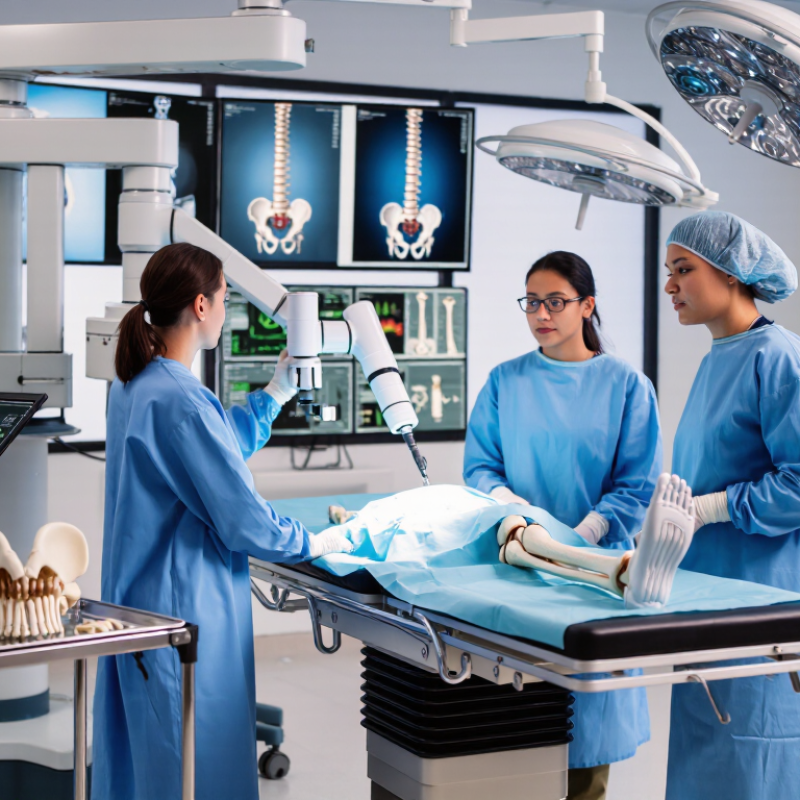
What Are the Top 10 Latest Trends in Orthopedic Technology?

AI Diagnosis and Robotic Surgery: Evidence Beyond FDA Clearance Data

Orthopedic technology is moving beyond implants and imaging. The latest ten trends include AI diagnosis, robotic surgery, navigation, 3D planning, smart implants, wearable monitoring, remote rehabilitation, digital twins, augmented reality, and patient-specific instruments. Yet FDA clearance is only one checkpoint. It does not prove superior recovery, long-term safety, or value in every hospital.

AI tools can flag subtle joint-space narrowing or possible fractures within seconds. However, performance may change across scanners, skin tones, age groups, and clinical settings. A reliable evaluation needs independent datasets, transparent error reporting, and comparison with experienced clinicians. Human review remains essential. False reassurance can delay treatment.

Robotic systems may improve alignment accuracy during knee or spine procedures. They can also increase planning time, training demands, and operating-room costs. Evidence should include revision rates, pain scores, mobility, complications, and patient-reported outcomes. Short follow-up is not enough. Real-world registries and peer-reviewed studies matter more than polished demonstrations.

The practical question is simple.Does the technology improve care? Clinics should track calibration, workflow interruptions, and unequal access after adoption. Surgeons need clear override options when software behaves unexpectedly. Patients deserve understandable explanations, not technical promises. Some tools will fail to deliver their early optimism. That is uncomfortable, but honest monitoring can reveal which innovations truly earn a place in orthopedic practice.

3D-Printed Implants and Navigation for 78.4M U.S. Arthritis Cases

What Are the Top 10 Latest Trends in Orthopedic Technology?

With 78.4 million U.S. adults expected to live with arthritis by 2045, orthopedic technology is moving toward more personalized care. The figure highlights a practical challenge: many patients need durable treatment, not simply faster procedures. The leading trends include 3D-printed implants, computer navigation, robotic assistance, artificial intelligence planning, patient-specific instruments, augmented reality, smart sensors, improved biomaterials, remote rehabilitation, and digital outcome tracking.

3D-printed implants can match a patient’s bone structure more closely. Surgeons may use CT-based models to plan porous surfaces, alignment, and fixation. This approach can help address unusual bone loss or complex joint anatomy. However, a precise implant does not guarantee a perfect result. Bone quality, infection risk, surgical technique, and rehabilitation still matter. The technology is impressive, but biology remains unpredictable.

Navigation systems provide real-time guidance during joint replacement and trauma surgery. They can show alignment angles and implant positioning on a monitor or surgical display. That feedback may reduce avoidable variation between procedures. Yet, navigation adds preparation, training, and cost. A surgeon must still interpret the patient’s anatomy rather than follow software blindly. The best teams combine digital measurements with physical examination and clinical judgment. I would not describe these tools as replacements for expertise. They are decision-support systems, and they can be wrong. Careful validation, transparent data, and long-term follow-up remain essential as orthopedic innovation expands.

Smart Implants and Wearables Addressing WHO’s 2.4B Rehabilitation Need

Orthopedic technology is moving beyond stronger plates and smoother joint surfaces. The major trends include smart implants, wearable sensors, robotic assistance, 3D-printed components, artificial intelligence, remote rehabilitation, regenerative therapies, augmented reality, minimally invasive tools, and connected clinical records. Together, these developments are reshaping how injuries are diagnosed, treated, and monitored.

Smart implants can measure pressure, loading, alignment, or healing activity inside the body. Surgeons may use this information to identify abnormal stress before pain becomes severe. A patient could receive a movement alert after walking unevenly or overloading a recovering joint. Wearable sensors add another layer by tracking steps, balance, range of motion, and exercise quality at home. This matters because the World Health Organization reports that about 2.4 billion people live with conditions that may benefit from rehabilitation. Clinics cannot provide constant supervision for everyone.

The technology still has weaknesses. Sensor data may be incomplete, especially when a device shifts on sweaty skin. Smart implants also require careful validation, long-term safety checks, and clear communication with patients. A useful signal is not automatically a useful decision. Access remains uneven, since advanced rehabilitation tools can be expensive or difficult to maintain in rural settings. In practice, clinicians should combine device readings with physical examination, patient feedback, and functional goals. Human judgment remains essential. Sometimes, the simplest walking observation reveals what a dashboard misses.

AR/VR and Digital Twins: AAOS Metrics for Virtual Orthopedic Planning

Orthopedic technology is moving beyond isolated imaging tools. Augmented reality overlays can place a planned implant axis over a patient’s anatomy. Virtual reality allows surgeons to rehearse complex procedures inside a three-dimensional model. These systems may improve spatial understanding before the operating room. However, visual realism does not guarantee clinical accuracy.

Digital twins add another layer. They combine scans, biomechanics, surgical plans, and recovery data into a patient-specific simulation. An AAOS-focused evaluation should track planning time, alignment error, complication rates, and revision frequency. It should also measure radiation exposure, training time, and clinician workload. Patient understanding matters too. A clear virtual model may make consent discussions more concrete.

The best test is not novelty. It is measurable improvement. A digital twin can predict stress around a joint, but tissue behavior remains difficult to model. Small imaging errors can distort the entire plan. That weakness deserves attention. In a practical workflow, surgeons should compare the virtual plan with physical landmarks and intraoperative findings. Independent validation is essential. Early results may look promising, yet small studies can overstate benefits. Cost, data security, and unequal access also require transparent reporting. A useful system should support clinical judgment, not replace it.

What Are the Top 10 Latest Trends in Orthopedic Technology? - AR/VR and Digital Twins: AAOS Metrics for Virtual Orthopedic Planning

Rank Technology Trend Core Orthopedic Application Key Data Inputs Virtual Planning Output AAOS-Aligned Planning Metrics Clinical Maturity Primary Evidence or Reference
1 AR/VR-Assisted Surgical Planning Immersive visualization of patient-specific anatomy for fracture reduction, joint reconstruction, resident education, and preoperative rehearsal. CT or MRI image volumes, three-dimensional anatomical models, surgical trajectories, and implant or instrument geometry. Interactive anatomy, planned osteotomy or fixation paths, and simulated surgical steps. Planning-to-execution deviation: angular error, entry-point error, procedure time, fluoroscopy exposure, and intraoperative plan changes. Early clinical adoption AAOS clinical education and technology resources; peer-reviewed orthopedic AR/VR studies.
2 Patient-Specific Digital Twins Creation of a computational model that represents an individual patient's anatomy, biomechanics, implant configuration, and recovery trajectory. Imaging, gait or motion data, implant geometry, bone-density estimates, laboratory results, and longitudinal outcomes. Scenario testing for implant position, load distribution, range of motion, and rehabilitation pathways. Model concordance: predicted versus observed range of motion, alignment, load distribution, complications, and revision-related outcomes. Emerging research National Library of Medicine literature database; digital-twin research in healthcare and biomechanics.
3 AI-Assisted Medical Imaging Automated detection, segmentation, classification, and measurement of fractures, deformities, cartilage loss, and implant positioning. Radiographs, CT, MRI, annotated image datasets, and structured clinical information. Three-dimensional segmentation, anatomical landmarks, deformity measurements, and risk flags for clinician review. Diagnostic and planning performance: sensitivity, specificity, segmentation overlap, measurement error, and calibration. Growing clinical use U.S. FDA AI/ML-enabled medical devices.
4 Robotic and Computer-Assisted Surgery Execution of preoperative bone cuts, implant alignment, balancing, and instrument navigation with software-assisted control. Preoperative CT or fluoroscopy, intraoperative registration, tracking markers, kinematic measurements, and implant libraries. Patient-specific alignment targets, constrained cutting boundaries, and real-time navigation feedback. Alignment and workflow: postoperative mechanical-axis error, component orientation, blood loss, operating time, and intraoperative adjustment rate. Established in selected procedures U.S. FDA medical-device information; orthopedic navigation literature.
5 Patient-Specific 3D Printing Production of anatomical models, surgical guides, custom implants, and porous structures for complex reconstruction. High-resolution CT data, segmentation files, material specifications, loading requirements, and manufacturing tolerances. Physical rehearsal models, cutting or drilling guides, and geometry customized to patient anatomy. Manufacturing and surgical accuracy: dimensional deviation, guide fit, correction angle, operative time, and complication rate. Targeted clinical use U.S. FDA: 3D Printing of Medical Devices.
6 Wearable Motion and Load Sensors Continuous assessment of gait, joint loading, activity, balance, and rehabilitation progress outside the clinic. Inertial measurement units, pressure sensors, electromyography, smartphone data, and patient-reported outcomes. Functional movement profiles, adherence trends, asymmetry detection, and individualized rehabilitation targets. Functional recovery: step count, walking speed, gait symmetry, joint range of motion, activity tolerance, and change from baseline. Growing clinical use National Institutes of Health digital health research; rehabilitation and biomechanics literature.
7 Remote Orthopedic Monitoring and Virtual Rehabilitation Hybrid follow-up, guided home exercises, wound or mobility checks, and earlier identification of recovery problems. Patient-reported outcome measures, video assessments, wearable signals, wound images, pain scores, and exercise logs. Risk stratification, adherence dashboards, alerts, and personalized therapy progression. Patient-centered outcomes: PROM change, adherence, unplanned visits, time to functional milestones, and patient satisfaction. Established telehealth pathway U.S. CMS telehealth information; orthopedic tele-rehabilitation studies.
8 Smart Implants and Implant Sensing Measurement of load, pressure, temperature, micromotion, or other signals to support implant surveillance and rehabilitation decisions. Embedded or external sensors, radiographs, activity data, clinical examinations, and laboratory results. Patient-specific loading profiles, early warning signals, and longitudinal implant performance records. Implant surveillance: load symmetry, micromotion, migration, infection indicators, pain trajectory, and revision-free survival. Emerging clinical research U.S. FDA medical-device guidance; implant sensor and arthroplasty research.
9 Digital Biomarkers and Predictive Analytics Use of aggregated clinical, imaging, functional, and patient-generated data to predict complications, readmission, delayed recovery, or revision risk. Electronic health records, imaging features, laboratory values, comorbidities, PROMs, activity data, and surgical variables. Risk scores, recovery curves, patient segmentation, and decision-support alerts. Prediction quality: area under the curve, calibration, sensitivity, false-alert rate, net benefit, and external validation performance. Validation-dependent National Library of Medicine literature database; clinical prediction-model methodology.
10 Interoperable 3D Data and Cybersecure Orthopedic Platforms Integration of imaging, planning, navigation, outcomes, and remote-monitoring data into traceable clinical workflows. DICOM imaging, HL7 or FHIR clinical data, implant metadata, surgical logs, PROMs, and access-control records. Longitudinal patient profiles, reproducible virtual plans, audit trails, and data exchange across care settings. Data quality and safety: completeness, interoperability rate, synchronization latency, auditability, access incidents, and plan reproducibility. Infrastructure priority DICOM Standard; HL7 FHIR interoperability framework.

Regenerative Biologics and Tele-Rehabilitation: FDA and WHO Benchmarks

Regenerative biologics and tele-rehabilitation are reshaping orthopedic care, but their value depends on evidence, regulation, and access. The World Health Organization estimates that 2.4 billion people could benefit from rehabilitation worldwide (WHO, Rehabilitation 2030). That figure includes patients recovering from fractures, joint replacement, and chronic musculoskeletal conditions.

Regenerative treatments now include cell-based products, tissue scaffolds, and platelet-derived approaches. However, biological promise is not the same as clinical proof. The U.S. Food and Drug Administration requires appropriate approval or investigational authorization for regenerative medicine products. Its guidance emphasizes manufacturing controls, patient safety, and clearly defined clinical outcomes. Pain relief alone may be insufficient. Function matters more.

Tele-rehabilitation extends supervised exercise beyond the clinic. A patient might complete balance training beside a kitchen chair while a therapist reviews movement data remotely. WHO’s Global Strategy on Digital Health 2020–2025 supports interoperable systems, privacy protection, and equitable access. FDA guidance on digital health technologies also stresses reliable data collection and patient monitoring.

The evidence remains uneven.

Some studies report strong adherence, while others reveal limited broadband access and inconsistent home measurements. Older adults may also need simpler interfaces and caregiver support. These weaknesses deserve attention, not polished marketing language. Orthopedic teams should compare biologic claims with trial quality, follow-up duration, adverse-event reporting, and measurable improvements in mobility. That standard protects patients and makes innovation more credible.

FAQS

Why is orthopedic technology becoming more personalized?

Many adults may live with arthritis in the coming decades. Personalized planning can match treatment to bone shape, movement, and joint damage. Faster surgery is not always better. Durability matters.

How can 3D-printed implants help patients?

CT scans can create a three-dimensional bone model. Surgeons may design implant shape, alignment, and porous surfaces more precisely. This may help with unusual bone loss. Biology still surprises us.

Do personalized implants guarantee better results?

No. Bone quality, infection risk, surgical technique, and rehabilitation still affect recovery. A precise implant cannot control every biological response. The promise is real, but incomplete.

What does computer navigation do during surgery?

Navigation systems show alignment angles and implant positions in real time. A monitor may display whether the planned position matches the actual position. This feedback can reduce avoidable variation.

Can navigation replace surgical expertise?

No. Software can be wrong. Surgeons must assess physical landmarks and patient anatomy. Training, preparation, and cost also increase. Digital measurements should support judgment, not replace it.

How are augmented and virtual reality used in orthopedic planning?

Augmented reality can overlay an implant axis onto a patient’s anatomy. Virtual reality can place surgeons inside a three-dimensional rehearsal. These tools may improve spatial understanding. Visual realism is not clinical proof.

What is a digital twin in orthopedic care?

A digital twin combines scans, movement data, surgical plans, and recovery information. It creates a patient-specific simulation. The model may estimate joint stress or compare possible treatments. Small imaging errors can distort the result.

How should hospitals evaluate new virtual planning tools?

They should measure planning time, alignment error, complications, revisions, radiation exposure, and staff workload. Patient understanding also matters. Long-term follow-up is necessary. Early studies can overstate benefits.

What challenges could limit these technologies?

High costs, data security concerns, training demands, and unequal access may limit use. Some tools need more independent validation. A useful system should improve care, not merely look impressive.

Conclusion

What are the latest trends in orthopedic technology? The field is rapidly moving toward data-driven diagnosis, robotic-assisted surgery, and personalized treatment planning. Artificial intelligence is helping clinicians interpret medical images and identify risks, while robotic systems support greater precision during procedures. Three-dimensional printing is enabling customized implants, and advanced navigation tools are improving surgical alignment for the millions of people living with arthritis in the United States. Smart implants and wearable devices are also being developed to monitor movement, recovery, and treatment outcomes.

At the same time, augmented and virtual reality, along with digital-twin models, are creating more realistic environments for surgical education, preoperative planning, and patient communication. Regenerative biologics continue to attract attention for their potential to support tissue repair, while tele-rehabilitation expands access to guided recovery services. Together, these technologies reflect broader clinical, regulatory, and public-health priorities, including safety evaluation, measurable outcomes, rehabilitation access, and more individualized orthopedic care.

Charlotte

Charlotte

Charlotte is a seasoned marketing professional with a deep understanding of the company's portfolio and a passion for elevating its presence in the market. With a keen eye for detail and a commitment to excellence, she ensures that our professional blog is regularly updated with insightful articles......